

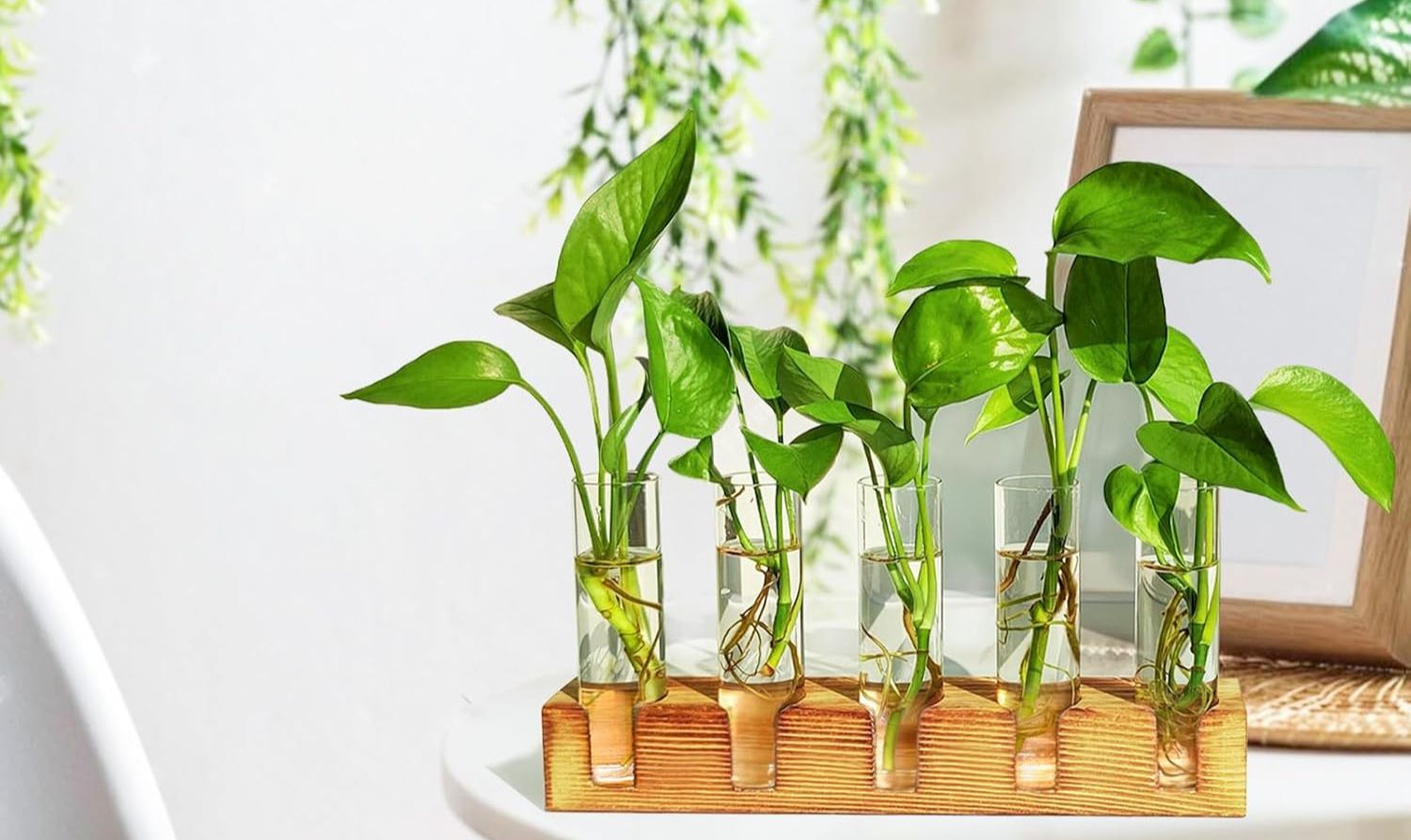
If you’ve ever rooted cuttings in random mugs or jars, you already know the upside: it works. You also know the downside: it can look cluttered, tip over easily, and make it hard to track progress. A plant propagation station solves those problems by giving you stable, matching vessels in a display-friendly setup.
The Renmxj Plant Propagation Station is a popular example because it blends a wooden stand with clear glass tubes. It’s meant to be functional, but it also acts like décor. The question is whether it’s worth using over DIY containers, and what limitations you should expect.
What a Plant Propagation Station Actually Does
A propagation station is a structured holder designed for water propagation. You place cuttings in water so nodes stay submerged while leaves remain above the surface. The clear glass makes it easy to see roots forming.
Compared with makeshift containers, a station typically improves:
- Stability (less tipping and spilling)
- Organization (multiple cuttings in one place)
- Visibility (root progress is easy to monitor)
- Presentation (it looks intentional, not improvised)
The Renmxj Station at a Glance
This model uses a compact wooden base with five borosilicate glass test tubes. It’s sized for shelves, windowsills, and desks.
Key specs (quick reference)
| Feature | What you get | Why it matters |
| Stand | Wood with burnt finish | Adds warmth, fits rustic/modern décor |
| Tubes | 5 borosilicate glass test tubes | Clear viewing, handles temp shifts better |
| Capacity | ~55 ml per tube | Enough for most single cuttings |
| Size | Compact desktop footprint | Easy placement in small spaces |
| Extra | Tube cleaning brush | Helps prevent algae/biofilm buildup |
How You Use It for Better Rooting Results
You’ll get the best results when you treat the station like a controlled mini-system, not a set-it-and-forget-it display.
Setup basics
- Fill each tube about 2/3 with room-temp water.
- Insert a cutting so at least one node is submerged.
- Keep leaves above the waterline to reduce rot.
Water and light rules that actually matter
- Water changes: every 3–5 days for most cuttings.
- Best light: bright, indirect light (direct sun can heat water fast).
- Cleaner tubes: rinse between plant types to reduce bacteria transfer.
If you want to boost clarity and reduce odor, you can add a tiny pinch of activated charcoal, but don’t overdo it. Too much can make cleaning harder.
Which Plants Work Best in Tube-Style Stations
Not all plants love water propagation, and tube size matters. With narrow test tubes, you’ll usually do best with stems that don’t need thick supports.
Good choices for most homes
- Pothos and philodendron (fast, forgiving)
- Tradescantia (quick rooting, easy to trim)
- Spider plant babies (simple and low-risk)
- Mint and basil (herbs that root reliably)
Plants that can be trickier
Woody stems (like rosemary) can root in water, but they often take longer and may rot if the cutting isn’t fresh or if the water goes stale.
Styling vs. Performance: Two Valid Perspectives
A propagation station sits at the intersection of plant care and décor, and people value it differently.
Perspective 1: You want a propagation tool first
You’ll like the station because it’s organized, stable, and makes progress obvious. It’s a system you can repeat weekly without collecting mismatched containers.
Perspective 2: You want a décor piece that also propagates
You’ll care more about the wood finish, symmetry, and how it looks on a shelf. In that case, you may propagate fewer cuttings at once, but you’ll enjoy seeing them daily.
Both perspectives are valid. The best choice depends on whether you’re optimizing for volume or for display.
Objections and Limitations You Should Know
Before you buy or commit to a station-style setup, it helps to be realistic.
“Isn’t this just jars with extra steps?”
It can be, if you already have stable containers and you don’t care about presentation. A station becomes worth it when you value consistent sizing, reduced clutter, and easier monitoring.
“The tubes look small.”
That’s the trade-off. Smaller tubes are tidy and attractive, but they:
- need more frequent water changes
- can crowd thicker stems
- may not suit large-leaf cuttings
“Will the wood get damaged?”
Wood can handle normal indoor humidity, but it doesn’t love constant splashes. You’ll want to wipe drips quickly and avoid soaking the base during cleaning.
When You Should Choose DIY Instead
DIY containers may be better if you:
- propagate many cuttings at once
- need wider containers for thicker stems
- want to keep costs minimal
- don’t mind mismatched jars on a windowsill
If you propagate casually and enjoy the “lab glass” look, a station is more satisfying than DIY.
A Simple Upgrade for Visible Growth
If you want a cleaner, more intentional way to propagate plants, a dedicated station makes the process easier to manage and more enjoyable to watch. You still need proper light and regular water changes, but the structure helps you stay consistent.
If you prefer larger cuttings or bulk propagation, jars may work just as well. But if you value both function and display, the Renmxj Plant Propagation Station offers a balanced solution — and it’s available on Amazon.