

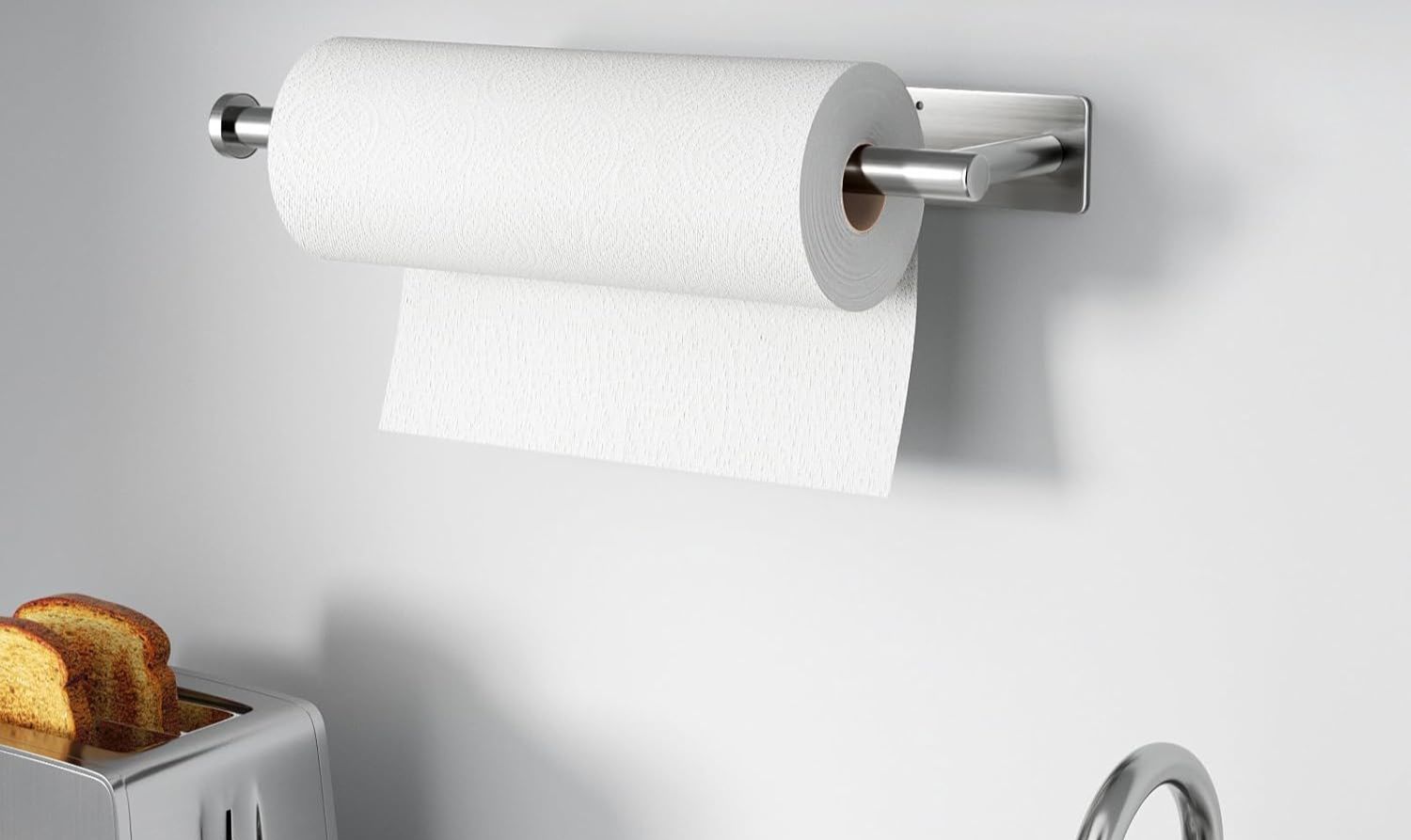
If your counter space feels cramped, a mounted paper towel holder is one of the fastest ways to declutter.
The niffgaff Paper Towel Holder (B0BLSKRJMP) is built around that idea. You get a slim stainless steel bar with two mounting options, so you can install it under a cabinet, on a wall, or inside a pantry door.
Still, the “best” choice depends on your space, your surfaces, and how often you grab paper towels. Below is a practical breakdown so you can decide if this holder fits your kitchen (or another room) without guessing.
What You’re Getting at a Glance
This holder uses SUS304 stainless steel and a brushed nickel finish. It’s designed to hold a standard paper towel roll while keeping a low profile. You can mount it with adhesive (no drilling) or with screws (more permanent).
If you want a clean setup and you’re tired of countertop holders sliding around, this approach usually feels like an upgrade. If you switch rolls constantly or your surfaces are rough, your install method matters more than the finish.
Key Features That Matter in Real Use
SUS304 Stainless Steel
SUS304 is a corrosion-resistant steel commonly used in damp environments. In a kitchen, that matters because steam, splashes, and humidity can quickly expose weak coatings.
If you want something that won’t rust or peel, stainless steel is a safer bet than painted metal. It also tends to hold up better than plastic when temperatures change.
Brushed Nickel Finish
A brushed finish typically hides fingerprints and small water marks better than glossy metal. It also blends well with modern fixtures and appliances.
That said, brushed nickel won’t perfectly match every hardware tone. If your kitchen leans matte black or brass, you may notice the contrast.
Two Mounting Options
You can mount it with adhesive for a quick, tool-free install. Or you can use screws if you want maximum stability.
Your best choice depends on the surface and how much force the holder will take in daily use.
Adhesive vs. Screws: Which Should You Choose?
You’ll see strong opinions on adhesive mounts. Some people love them. Others don’t trust them. The truth sits in the middle.
Adhesive works well when:
- You’re mounting to smooth, clean surfaces (tile, glass, sealed wood, metal)
- You’re renting or avoiding holes
- You’ll give it time to cure before use (often 24 hours)
Screws work better when:
- Your surface is textured, porous, or dusty (unfinished wood, painted drywall, rough tile)
- You pull towels quickly and often
- You want a “set it and forget it” mount for years
Quick Surface Fit Guide
| Surface type | Adhesive mount | Screw mount | Notes |
| Smooth tile | Strong | Strong | Clean well first |
| Glass | Strong | Not typical | Adhesive is usually enough |
| Sealed/finished wood | Strong | Strong | Ideal for under cabinets |
| Painted drywall | Mixed | Strong | Screws are safer |
| Rough/porous tile | Mixed | Strong | Adhesive may fail over time |
| Unfinished wood | Weak | Strong | Adhesive struggles to bond |
Where You Can Use It Beyond the Kitchen
You’re not limited to under-cabinet placement. This style of holder can work in several areas, especially where space is tight.
Common placements:
- Under cabinets near your prep zone
- Inside a pantry or cabinet door
- On a bathroom wall for hand towels or spare toilet rolls
- In a laundry room for cleaning cloths
- In a garage or workshop for shop towels
- In an RV or camper where every inch counts
If you plan to use heavier “jumbo” rolls or shop towels, you’ll likely prefer screw mounting.
Multiple Perspectives: Who This Is For (and Who May Skip It)
If you’re a renter
You may like the adhesive option because it avoids holes. Your limitation is that removal can damage paint or peel finishes if you rush it. If you’re mounting on painted drywall, consider screws only if you have permission.
If you’re a homeowner
You might prefer screws from the start. It’s typically the most stable setup, especially in high-traffic kitchens. You trade flexibility for permanence.
If you care about aesthetics
The brushed nickel look is clean and “quiet.” It won’t dominate your space like bulky countertop holders. But if your fixtures are not in the same finish family, it may not match perfectly.
If you want the cheapest option
This may not be your pick. Lower-cost plastic holders exist, and some work fine short-term. The tradeoff is that plastic can crack, discolor, or loosen faster with heat and time.
Potential Objections and Limitations (So You’re Not Surprised)
Here are the common concerns people run into with mounted holders, including this style:
- Adhesive failure on poor surfaces: If the surface isn’t smooth, clean, and dry, adhesive can weaken and detach.
- Placement mistakes: If you mount it too close to a cabinet edge, roll changes can feel cramped.
- Finish mismatch: Brushed nickel is versatile, but it’s not universal.
- Not ideal for constant tugging: If your household yanks towels quickly, screw mounting is safer.
If these sound like your situation, the fix is usually simple: choose screws, choose the right location, and measure before sticking it down.
How to Decide in 30 Seconds
Choose this holder if you want:
- Counter space back
- A clean mounted look
- A stainless steel build that suits humid rooms
- The option to install with adhesive or screws
Skip it (or plan screw mounting) if:
- Your mounting surface is rough or dusty
- You need the most heavy-duty stability
- You frequently use oversized rolls and pull aggressively