

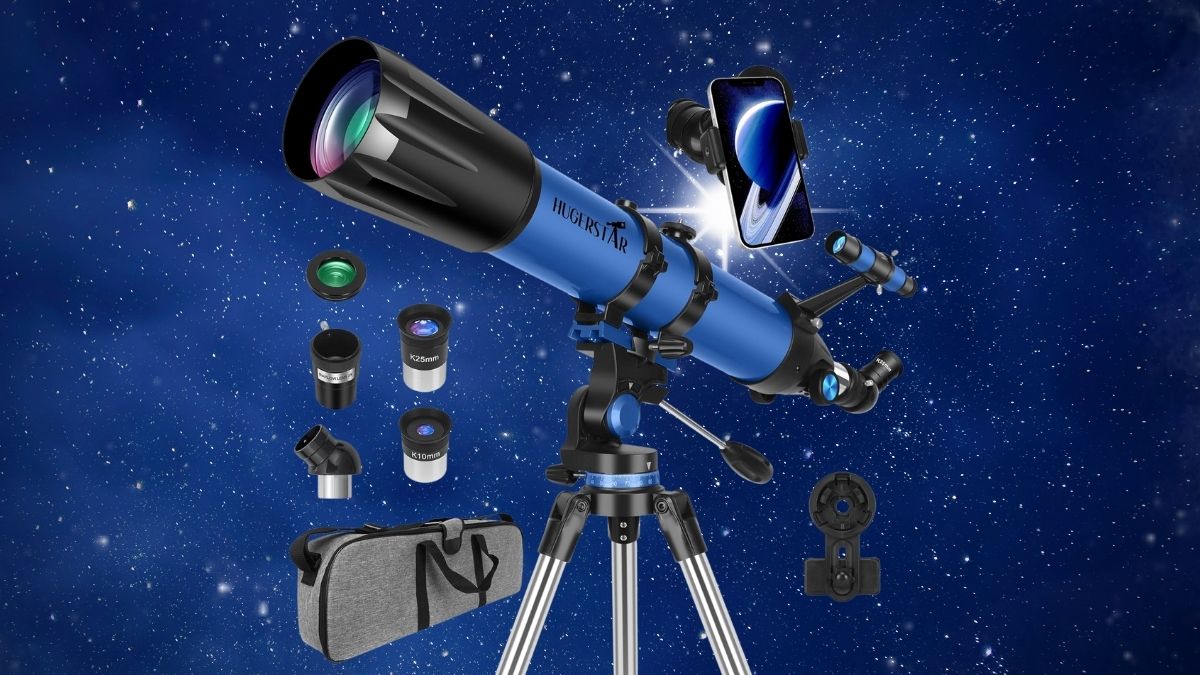
A telescope can be “high-powered” on paper and still disappoint at night. The difference usually comes down to optics you can actually use, a mount you can control, and accessories that help you learn faster.
If you want a capable scope for adult stargazing that does not feel like a science project every time you set it up, the HUGERSTAR 90mm Refractor is built for that lane.
With a 90mm aperture and an 800mm focal length, it sits above basic department-store telescopes. You get brighter images, more detail on the Moon and planets, and enough reach to start exploring brighter deep-sky objects. Most important, you can do it without constant maintenance or complicated alignment.
What “high-powered” means when you’re actually observing
Marketing often treats magnification as the main number. In real observing, aperture matters more because it controls how much light you gather and how much detail you can resolve.
The specs that influence what you see
- Aperture (90mm): More light and better resolution than common 60–70mm starters
- Focal length (800mm): Supports planetary magnification while keeping views manageable
- Eyepieces and Barlow: Determine practical magnification choices night to night
This is why a 90mm refractor often feels like the first “real” telescope for many adult beginners.
Optical performance and what to expect in real conditions
The HUGERSTAR’s 90mm refractor design is aimed at crisp, high-contrast viewing. Refractors are also easier to live with because they are sealed and do not need mirror collimation.
Here’s how the included magnifications translate to actual use.
Included magnification options that make sense
- 25mm eyepiece (32×): Easier object locating, wider views, star clusters, full Moon framing
- 10mm eyepiece (80×): Lunar detail, planetary disks, tighter framing
- 25mm + 3× Barlow (96×): Strong Moon and planet detail when the air is steady
- 10mm + 3× Barlow (240×): “Max power” option, but only useful on excellent nights
A key reality: atmospheric conditions often limit what you can use comfortably. Many nights, the most pleasing views land around 80× to 150×. That is still plenty for Jupiter, Saturn, and lunar terrain.
Setup, mount control, and day-to-day usability
A telescope can have good optics and still be frustrating if tracking is shaky. This model uses an altazimuth mount, which is intuitive because you move it up/down and left/right.
Before you start observing, you want a setup process that does not steal your motivation.
What the setup experience feels like
- Tripod opens quickly and stabilizes with the accessory tray
- Optical tube mounts without complicated hardware
- Finder alignment takes a few minutes, then pays off every session
- Slow-motion controls help fine-tune aim at higher magnification
Tracking is manual, so you will make frequent small adjustments, especially at higher power. The upside is you build real sky-navigation skill instead of relying on automation.
What you can see with a 90mm refractor
This is where a 90mm aperture earns its reputation. You will not just “find” objects. You will start to notice structure.
Before you plan your first sessions, it helps to set realistic targets.
Moon and planets
- Moon: Craters, ridges, mountain shadows, and surface texture jump out
- Jupiter: Four main moons are easy; cloud bands are visible in steady air
- Saturn: Rings are obvious; separation from the planet is clear
- Mars: Best during favorable approaches; surface shading can appear
Bright deep-sky objects
- Orion Nebula (M42): Visible shape and brighter structure under darker skies
- Pleiades: Wide, pleasing cluster view at low power
- Andromeda (M31): Bright core and extended glow under good conditions
If you observe from a city, planets and the Moon will still shine. Darker skies mainly improve nebulae and galaxies.
Accessories that add real value
Some telescope bundles include extras that feel like filler. Here, the add-ons are actually usable.
- Moon filter: Cuts glare and improves comfort on brighter lunar phases
- Smartphone adapter: Best for Moon shots and quick planet captures
- Carry bag: Helps with storage and transport without stress
You can also add standard 1.25-inch eyepieces later, which keeps your upgrade path open.
Where the value lands
For adult stargazing, this package is strongest if you want a step up from entry-level without paying premium refractor pricing. It is also a good fit if you want straightforward setup and sharp lunar and planetary views.
This telescope is featured within Amazon New Best Sellers in the Telescopes category, and you can explore more products in that same category to compare apertures, mounts, and accessory bundles.