

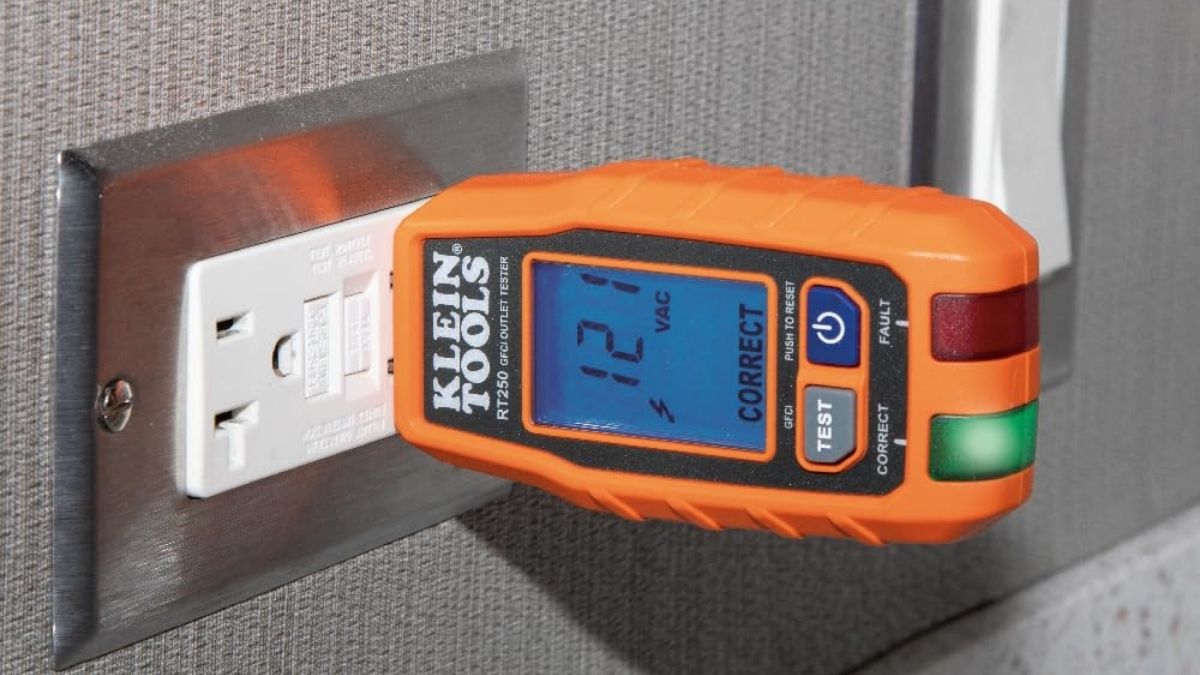
Outlet testers look simple, but the results can carry real consequences. A standard LED-only tester can tell you if something is “wrong,” but it often can’t tell you how wrong, or how close a safety device is to failing. That matters when you’re checking outlets in kitchens, bathrooms, garages, outdoor circuits, or any area where GFCI protection is required.
The Klein Tools RT250 GFCI Outlet Tester with LCD Display is built for clearer answers. You get a backlit LCD that shows numerical voltage readings and GFCI trip time, plus LEDs that give quick visual confirmation. If you’re a homeowner, maintenance tech, home inspector, or electrician, this tool helps you document conditions and spot problems early, not after something trips, sparks, or damages equipment.
What Makes the RT250 Different From Basic Outlet Testers
Most low-cost testers rely on light patterns. The RT250 keeps that convenience but adds measurable data.
- Backlit LCD display shows exact voltage instead of only “pass/fail” lights.
- Clear fault labels reduce guesswork when you’re reading results quickly.
- LED + LCD feedback lets you confirm status at a glance while still seeing details.
You’re not just checking if an outlet works. You’re checking whether it’s working correctly.
Why GFCI Trip Time Matters When You Test
A GFCI outlet is designed to shut off power fast when it senses a ground fault. The built-in “TEST” button on the outlet confirms it trips, but it doesn’t tell you how fast it responds. Over time, a GFCI can weaken or degrade and still reset normally.
With the RT250, you can measure GFCI trip time in milliseconds. That gives you a better signal of performance trends and helps you decide when replacement is smarter than “wait and see.”
When you’re testing safety devices, speed is the point.
Key Features You’ll Actually Use
The RT250’s value comes from a few practical upgrades that improve how you work.
- Auto-hold reading: you can remove the tester and still view the last result.
- Backlit display: helps when you’re in dim rooms, basements, panels, or crawl spaces.
- Rugged build: designed for jobsite handling, including drop resistance.
- Battery-powered operation: runs on AAA batteries with an auto-off feature to preserve power.
These features matter most when you’re testing many outlets or working in awkward spots.
What Wiring Problems You Can Identify
The RT250 can help you recognize common wiring issues that can lead to shock risk, device damage, or unreliable power. Your screen shows a fault label, and the LEDs reinforce whether the condition is safe.
You may see results like:
- Correct wiring
- Open ground
- Open neutral
- Open hot
- Hot/neutral reverse
- Hot/ground reverse
- Dual open conditions
If you’re troubleshooting older homes or renovation work, these are exactly the problems you want to catch early.
How You Should Use the RT250 Step by Step
You don’t need special training, but your process matters for accurate results.
- Plug the RT250 fully into the outlet and keep it steady.
- Read the voltage and wiring status on the LCD.
- Use the LEDs as a quick check, then rely on the LCD label for the exact condition.
- For GFCI outlets, press the tester’s GFCI test button and watch for:
- a trip response
- a displayed trip time (milliseconds)
- a “did not trip” warning if it fails
If you get an unexpected result, test again after reseating the tester. Loose receptacles can affect readings.
Who Benefits Most From This Tester
The RT250 fits several real-world roles because it gives you both speed and documentation.
- Homeowners: you can confirm safety before plugging in major appliances or electronics.
- Home inspectors: you can add measurable voltage and trip-time data to reports.
- Property managers: you can verify GFCI performance during turnover and maintenance.
- Electricians and maintenance staff: you can diagnose faster and reduce uncertainty on calls.
If you test outlets often, the extra detail saves time and reduces missed issues.
Is It Worth It?
If you only need a quick “wired or not” check once a year, a basic tester may feel enough. But if you want voltage numbers, clearer fault identification, and GFCI trip time, the RT250 gives you more useful information without moving into bulky meter territory.
If your goal is to confirm outlet safety with better clarity and fewer assumptions, this tool earns its place in your kit.