

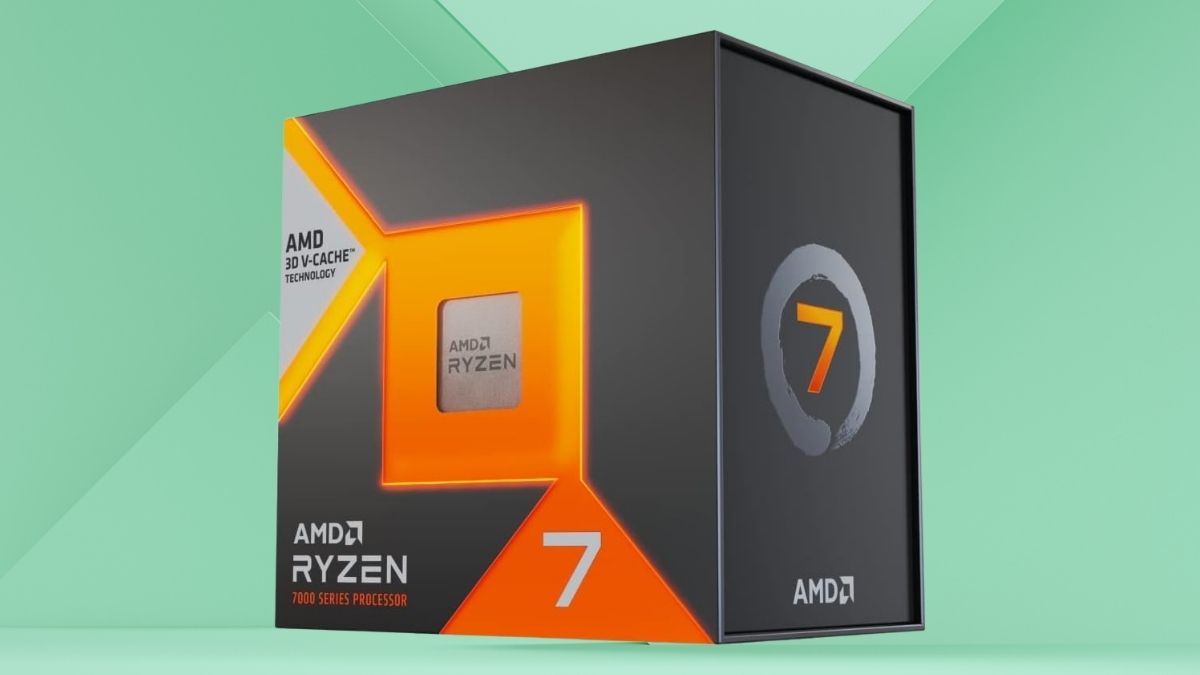
Even in a market flooded with shiny new processors, some chips manage to hold their ground.
The AMD Ryzen 7 7800X3D—first released in 2023—has proven to be one of those rare exceptions. With its massive 96MB L3 cache and power-efficient 8-core Zen 4 design, it’s still a go-to pick for gamers in 2025.
Is it still worth considering this older but battle-tested CPU? Let’s break down what makes it tick—and why it still matters.
Zen 4 and 3D V-Cache: Architecture That Changed the Game
At the heart of the Ryzen 7 7800X3D is AMD’s Zen 4 architecture, built on TSMC’s 5nm process (for the compute die) and 6nm for the I/O die.
This setup offers improved instructions per clock (IPC), better power efficiency, and higher overall performance compared to its predecessors.
But the real star here is AMD’s 3D V-Cache—a technology that vertically stacks an additional L3 cache layer on top of the CPU die.
That’s how this chip ends up with 96MB of L3 cache, three times the amount in the 7700X. The result? Less reliance on slower system RAM, and far faster access to frequently used data.
The Single CCD Advantage
Unlike AMD’s higher-end chips that use multiple chiplets, the 7800X3D opts for a single CCD (Core Complex Die). Why does that matter?
- No inter-chiplet communication means lower latency
- Uniform cache access across all cores
- Smoother, more predictable gaming performance
- Lower thermal density—great for heat management
While it doesn’t hit the clock speeds of its sibling, the Ryzen 7 7700X (5.0 GHz vs. 5.4 GHz), the extra cache means this CPU runs circles around it in many real-world gaming scenarios.
Performance That Still Impresses
With its forward-thinking architecture and massive L3 cache, the Ryzen 7 7800X3D sets the stage for performance that continues to rival newer releases—especially where it counts most for gamers.
Gaming, Two Years Later
If you’re playing modern AAA titles in 2025—like Microsoft Flight Simulator 2024 or Total War: Warhammer III—this chip continues to shine. Thanks to that massive L3 cache, the 7800X3D holds a lead in games that rely on rapid data retrieval, such as open-world or simulation-heavy titles.
1% Lows and Smoothness
What sets this chip apart isn’t just average FPS. It’s the consistency—those crucial 1% low frame rates that measure how smooth gameplay really feels.
The large cache minimizes memory latency spikes, keeping frame time dips to a minimum. Fewer stutters, smoother experience.
Compatibility with Modern Engines
Current-gen games are increasingly optimized for cache-heavy CPUs—especially those aligned with console architecture. The 7800X3D’s design parallels the cache-heavy setups in PS5 and Xbox Series X, making it a natural fit for modern PC ports.
Specs Snapshot and System Requirements
Here’s a quick look at the key specs:
- Base Clock: 4.2 GHz
- Boost Clock: 5.0 GHz
- TDP: 120W
- Socket: AM5
- Memory: DDR5 only (dual-channel DDR5-6000 or better recommended)
- PCIe: Gen 5 support (24 lanes)
You’ll need an AM5 motherboard—options range from budget-friendly B650 boards to premium X670E models. DDR5-6000 kits have become more affordable, with 32GB kits now starting around $130.
Also, no cooler is included. Aim for at least a solid mid-range air cooler or 240mm AIO.
Productivity: Capable but Not the Best
While the Ryzen 7 7800X3D nails gaming, it’s more of a mixed bag in productivity tasks.
- Strong at:
- Software development
- Photo editing
- Audio production
- Light-to-moderate streaming
- Light 3D rendering
- Falls short in:
- High-core-count workloads (video rendering, heavy 3D animation)
- Multitasking-intensive professional use cases
If your workflow includes demanding creative tasks, a Ryzen 9 or an Intel i7/i9 with more cores may serve you better.
Thermals and Tuning
Thermal efficiency is another strong point. Even under load, the 7800X3D stays relatively cool with a good cooler—around 65–75°C in games, and up to 85°C under full load.
However, overclocking is limited. Due to the sensitive nature of 3D V-Cache, manual multiplier-based overclocking is disabled. But you can still tweak performance via:
- Precision Boost Overdrive (PBO)
- Curve Optimizer (undervolting with positive results)
- Memory tuning
With Curve Optimizer, many users report better thermals and sustained boost performance by applying negative offsets (-15 to -30 per core is common).
Price and Value in 2025
At around $384.59, the Ryzen 7 7800X3D remains a compelling option for gamers. It may not have the highest core count, but in cache-sensitive games, it still outpaces much of the newer competition.
Total Platform Cost:
- CPU: $384.59
- Motherboard (B650): ~$160+
- 32GB DDR5-6000: ~$130–180
It’s a mid-to-high-end setup that provides longevity—especially given AMD’s continued AM5 socket support through at least 2025 (and likely beyond).
For gamers, the 7800X3D often beats Intel’s Core i7-13700K in real-world gaming. And while the i9-13900K might edge it out in some scenarios, it’s usually at a much higher cost—and often with higher power consumption and thermals.
The Final Word: Built to Last
Two years after launch, the Ryzen 7 7800X3D is still at the top of its game—literally. If your priority is top-tier gaming performance with rock-solid efficiency and future-ready platform support, this CPU is hard to beat in 2025.
You’ll need to invest in a good cooler and DDR5 memory, but what you get in return is a processor that delivers consistent, high-end gaming without needing constant upgrades. In a rapidly shifting CPU market, that kind of staying power is rare—and valuable.
The AMD Ryzen 7 7800X3D is widely available on Amazon, often bundled with promotions or motherboard combos. Be sure to factor in cooling and DDR5 memory for your total budget.